Most intake delay is not caused by typing. It comes from repeat checking, document chasing, and status drift. One missing passport page becomes three follow-ups, then attorney review starts with half the story and all the risk.
What actually slows intake QA down
Firms usually do intake QA in fragments: one person checks forms, another checks documents, and attorney review discovers the missing pieces late. The work exists, but the sequence is messy.
That creates avoidable rework. Dates get re-entered, supporting records are hunted down twice, and no one has a clean answer to a simple question: is this matter ready for review or still missing something important?
What a better workflow looks like
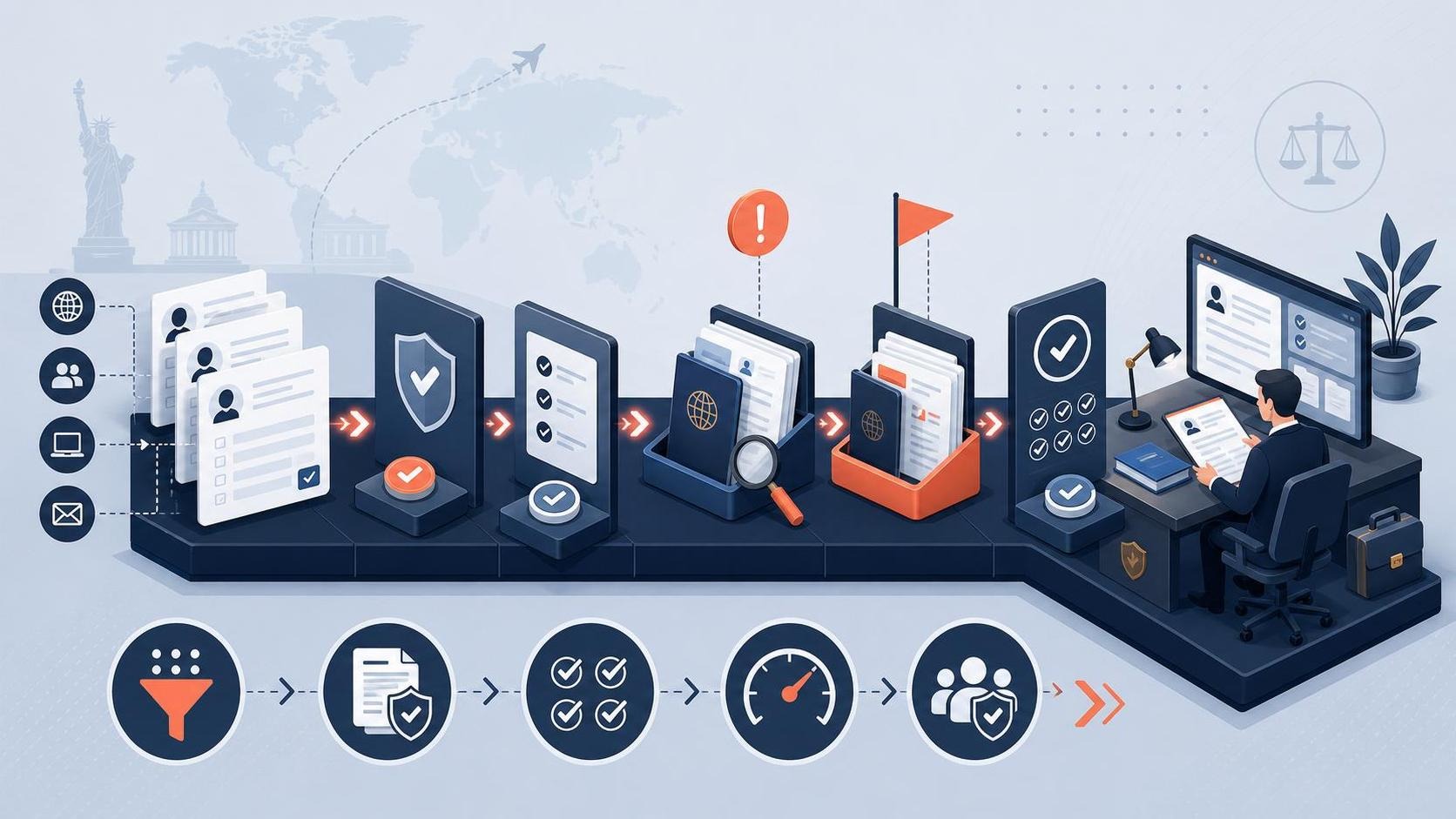
A stronger workflow moves through five clear stages: intake capture, required-document validation, exception review, packet assembly, and attorney handoff. Each stage has one owner and one exit rule.
That matters because teams do not need more reminders. They need a system that makes readiness visible. If the marriage certificate is missing, if translations are incomplete, or if an address history has gaps, the matter should stop itself before it wastes attorney time.
The minimum data every intake QA lane should track
Track the matter type, client name, filing deadline if relevant, document checklist status, missing-item count, translation flags, address-history completeness, signature status, and current owner. Keep it boring and standard. Fancy labels are how simple operations become archaeology.
Add stage timestamps too: intake received, checklist completed, exceptions flagged, packet assembled, and attorney review started. Those timestamps tell you whether the drag is with clients, internal ops, or legal review.
Use an intake exception card before a matter reaches an attorney
A missing-item count is not enough. Every blocked matter needs one short exception card that tells the operator what failed, who owns the next move, and what evidence clears the issue. This keeps follow-ups from becoming a game of inbox archaeology.
| QA check | Flag when | Owner | Exit evidence |
|---|---|---|---|
| Identity packet | A passport page, ID, or name match is absent or unclear | Client coordinator | Readable replacement uploaded and linked to the matter |
| Timeline and addresses | A date range, address period, or employment gap conflicts or is blank | Intake specialist | Client-confirmed correction recorded in the intake record |
| Translation or legibility | A required translation is missing or an upload cannot be reviewed | Document operations | Usable document and translation attached, with the old file retained for traceability |
| Attorney question | The issue needs legal judgment rather than more document collection | Assigned attorney | Written disposition or next-request instruction added to the exception card |
Automation can draft the exception card from the intake form and uploaded files, but it should route uncertain or conflicting facts for human review. It is a queueing aid, not a legal-sufficiency decision.
Where AI helps without making legal judgment calls
AI is useful when it structures intake noise. It can compare uploads to a required checklist, flag likely document gaps, detect duplicate or low-quality files, and summarize open issues in one review-ready note.
It should not decide legal sufficiency. The legal call stays with the team. The win is that attorneys stop spending time finding missing pieces and spend more time reviewing substance.
A practical checklist firms can use this week
Use one intake QA board with clear statuses: received, validating, waiting on client, ready for packet, ready for attorney, and approved. Then define exactly what moves a case from one state to the next.
For example, ready for attorney should mean identity documents are present, intake answers are complete, translations are attached where needed, and unresolved exceptions are summarized in one note. If that is not true, the status is lying.
What to measure
Track average time from intake received to intake complete, number of follow-ups per matter, percentage of matters sent back from attorney review, and the most common missing-document categories.
Those metrics show whether the workflow is cleaner or just louder. If attorney bounce-backs stay high, the issue is not speed. It is upstream quality.
Rollout plan
Start with one matter type and one checklist. Standardize the intake fields, enforce required uploads, and log why matters get blocked. Then add AI summaries only after the process is stable enough to deserve them.
Otherwise you end up automating confusion. That saves nobody any time, but it does create very confident dashboards.
A simple readiness rule that saves real time
Before attorney review begins, the matter should answer three questions without opening six tabs: what is missing, who owns it, and what changed since the last check. If the team cannot answer those instantly, the case is not actually review-ready.
That single rule eliminates a lot of fake progress. A full inbox is not the same thing as a prepared file.
Why this matters for immigration teams
Intake QA is where avoidable delay first becomes expensive. When firms tighten this step, everything downstream moves faster: packet prep, attorney review, client follow-ups, and filing confidence.
If your team is still running this from inbox threads and memory, the bottleneck is not effort. It is design.
Build the handoff around the work your team already does
Pair this QA lane with a structured immigration intake automation workflow and a document collection queue. The goal is not more software. It is one visible path from client upload to review-ready file.
InceptionAI helps immigration firms turn intake QA into a structured, review-ready workflow with clearer status, fewer misses, and less back-and-forth before attorney review starts. Map your current intake exceptions with our team.